
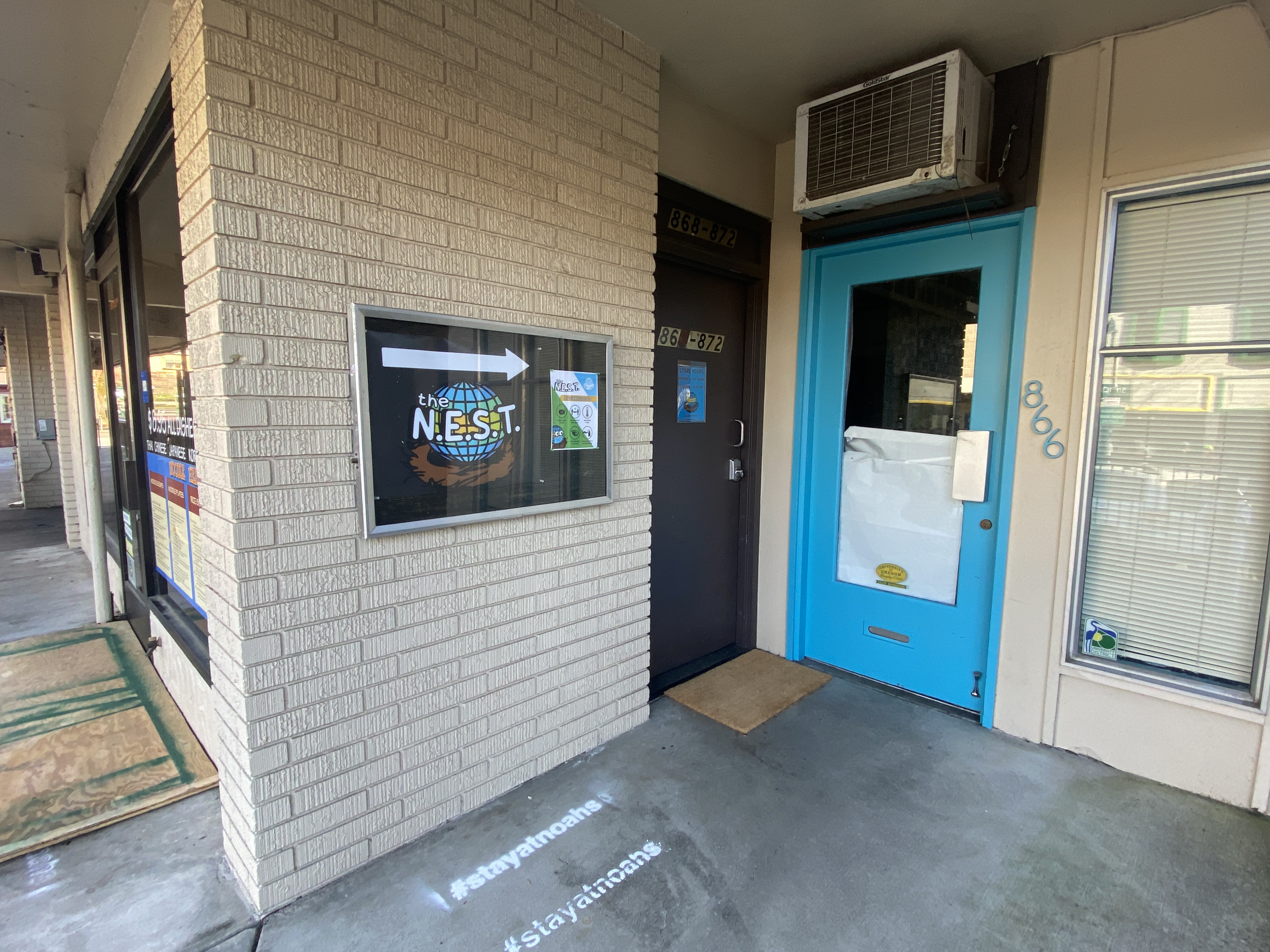
The Neighborhood Eugene Sustainability Team, also known as The N.E.S.T., has been buzzing since its grand opening in January 8, 2021. As a University of Oregon student who loves anything vintage, interviewing this small, local business seemed fitting. Harrison Stevens, a UO graduate, and Eduardo Olivares, a senior at UO, founded this business in the midst of their college careers. The N.E.S.T. offers a wide variety of Oregon gear and merchandise, as well as other thrifted treasures. Located on East 13th Avenue, I scoped out the place and talked to Stevens and Olivares about their sustainable business.
Q + A with Harrison Stevens
Nikoline: Can you describe the general background of The N.E.S.T.? How did it begin?
Harrison: Great question. In synopsis, The N.E.S.T began out of Eduardo and I’s shared love for shared passion for vintage clothing. We were both operating as separate entities in 2019. And after we met at the U of O, and did a couple of joint pop ups together (still as separate entities) The N.E.S.T. was kind of born out of necessity to collaborate instead of compete. In June 2020, we kind of put our heads together and came under one roof.
Nikoline: With an uprise of vintage resellers, what makes you different from other kind of vintage shops?
Harrison: I think that there’s a couple things that kind of separate us from other vintage stores. We do recognize that we’re on a college campus, and that we’re catering towards a college market. So if you notice, our pricing is about 10 to 15% below market value of what you could get that piece for online. Another thing that separates us from other vintage sellers throughout the nation is our sustainable essentials. In Eugene, at least, there really isn’t a place you can get a nice t-shirt for under $25. We have a rack of $20 t-shirts of all hand curated, vintage tees that students can shop from– that’s a form of sustainable self expression. They’re unique. You’re going to be the only person on campus that has that.
Nikoline: What does sustainability mean to The N.E.S.T.?
Harrison: Extending products, life cycles and giving garments that would otherwise be looked over a second lifespan. In Eugene, so many University of Oregon alumni, so many memories made on this campus. People have sweatshirts, t-shirts and gear that they really cherish. I think it’s cool seeing those pieces come back to us and then being able to redistribute them through the community and essentially giving them like a second life cycle.
Nikoline: So this is a super cliche question, but where do you see The N.E.S.T. in the next five years? What’s the future vision or ultimate goal that you guys have for The N.E.S.T.?
Harrison: In the next five years, I would like to see us be a continuing the same model at a different college campus within the PAC 12– preferably in Southern California. In the near future, we’re going to get this space rocking and rolling. Hopefully by spring term, we will start to introduce some more of our N.E.S.T. branded products. Already, we’ve got hats and some other pieces that we’re working on. Just continuing to build the brand’s presence behind the name and making sure that everybody that comes in is having a unique experience.
Q + A with Eduardo Olivares
Nikoline: How did you initially get into vintage resale?
Eduardo: In high school, I would just casually thrift for myself. My friends started noticing that I started wearing cool stuff. They were like ‘Yo,’ were you getting this? Fast forward to college, I knew that Harrison sold vintage. I wanted to do something like that on my own. So I began to page called ‘Bounce Factors,’ which is how I got my beginning. I remember I messaged Harrison randomly one day–I had no connection with this guy whatsoever– before I met him. I was just like, ‘Yo, I love what you’re doing. Let me just take you out to Chipotle and we can just talk t-shirts.’ So we met up and just talked for a couple hours. We realized that we both had, similar goals and aspirations and were very knowledgeable about vintage. He invited me to be part of his booth the following week for the street fair.
Nikoline: How was it like opening a physical business in the midst of a global pandemic?
Eduardo: I think it was a blessing and a curse. Obviously, it was a hard time for everyone. If we can go through this, we can go through anything. We had opened up an appointment only model. So basically, people had to book an appointment or Instagram message us in order to come shop. I think that added a special element to it as well, like this sense of like exclusivity. People would come to the shop and talk to their homies about us.
Nikoline: As a clothing store, what do you guys do to be a sustainable brand?
Eduardo: Sustainability is a big part of the brand. So we try to do our best. The poly mailers that we use, they’re all sustainable. Even our fixtures in the shop– none of them are new. We basically rebuilt it to make it new. Pretty much everything in our store is sustainably sourced, which is a big part of our brand and just how we live.
Nikoline: On your Instagram bio, it says, “Building a community through vintage clothing.” How do you guys promote this through your brand?
Eduardo: I was born in Mexico, but I’ve grown up in Eugene since I was five years old. So Eugene is my home. Being able to do something like this [in Eugene] is definitely huge for me and that’s how this whole community aspect is built. Just being so close to the University of Oregon, we’re just able to connect with so many creative young people. Especially our photoshoots, we connect a lot with student athletes. The photographer’s are normally students as well. We had some design, students build our fixtures upstairs [at The N.E.S.T.]. There’s a lot of talent in the University of Oregon. What we want to do is also just be an outlet for creativity. Hopefully, down the line, we’ll have the resources to offer those types of services and really be another resource for college students. Harrison and I are students, so we understand kind of the struggles, and I think it’s it’s a really close connection, we have a campus.
 Nikoline Porse
Leave a comment